



The Nobel Assembly at Karolinska Institutet in Sweden awarded the 2026 Nobel Prize in Physiology or Medicine to three scientists for their revolutionary discoveries in the field of optogenetics and light-sensitive ion channels. The prize was jointly won by American researcher Karl Deisseroth (Howard Hughes Medical Institute and Stanford University) and German scientists Peter Hegemann (Humboldt University of Berlin) and Georg Nagel (University of Würzburg).
The prize money, totaling 12 million Swedish kronor (approximately $1.2 million), was divided equally among the three researchers. This groundbreaking method makes it possible to switch the activity of individual nerve cells on and off in a living brain using light. Widely utilized in numerous laboratories across the world today, optogenetics has ushered in a brand-new era in neuroscience.

The journey of discovery from algae to brain cells
How the brain controls emotions, behaviors, and bodily functions has long been one of the scientific world’s greatest enigmas. Although researchers in the 20th century began mapping which functions were associated with different brain regions, the techniques available to them were not sufficient to prove direct causal relationships.
The process began when Peter Hegemann wondered how a single-celled green alga known as Chlamydomonas swims toward light. In the early 2000s, Hegemann and Georg Nagel discovered an extraordinary protein called channelrhodopsin on the cellular surface of this alga. When illuminated with blue light, a channel within the protein opens, generating a cellular electrical impulse via the influx of charged ions. The researchers determined that every cell into which they introduced this protein became sensitive to light.
Controlling brain signals with light in living brains
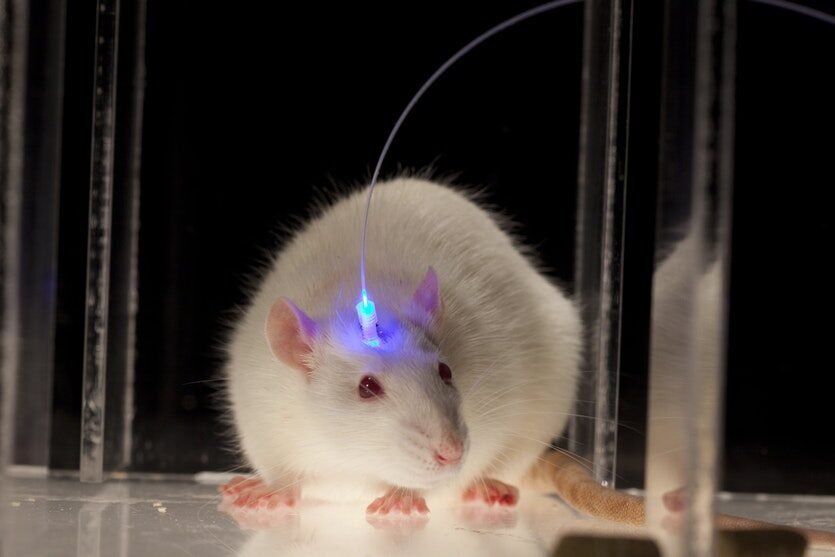
Karl Deisseroth achieved the first major breakthrough by transferring the channelrhodopsin gene into nerve cells derived from rats. Successfully triggering neuronal signals by applying blue light, Deisseroth published this historic study in 2005. Two years later, he succeeded in making this light-controlled cellular switch functional in the brains of living mice.
Dubbed optogenetics, this technique has enabled the deciphering of neural circuits underlying memory, emotion, and behavior that form the basis of neurological and psychiatric disorders. Today, the method is also being actively tested in clinical medical research, particularly in studies aimed at restoring vision in visually impaired individuals.
Source
The Nobel Assembly at Karolinska Institutet. Press release: The 2026 Nobel Prize in Physiology or Medicine. NobelPrize.org (2026). https://www.nobelprize.org/prizes/medicine/2026/press-release/
