

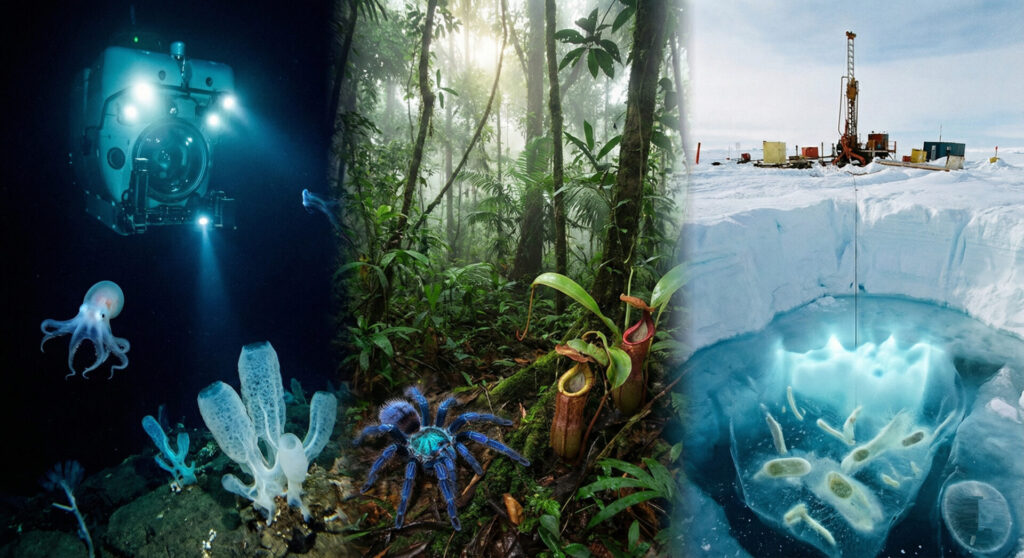
Even in the 21st century, Earth remains a world of hidden wonders. While satellites map every corner of the surface and deep sea submarines dive into the abyss, scientists continue to discover new species that defy imagination. From mysterious creatures dwelling in the dark trenches of the oceans to unexpected lifeforms surviving under the frozen wastelands of Antarctica, the diversity of life on our planet keeps surprising us. These recent discoveries remind us that Earth is still largely unexplored and full of secrets waiting to be revealed.
Mysteries of the Deep Sea
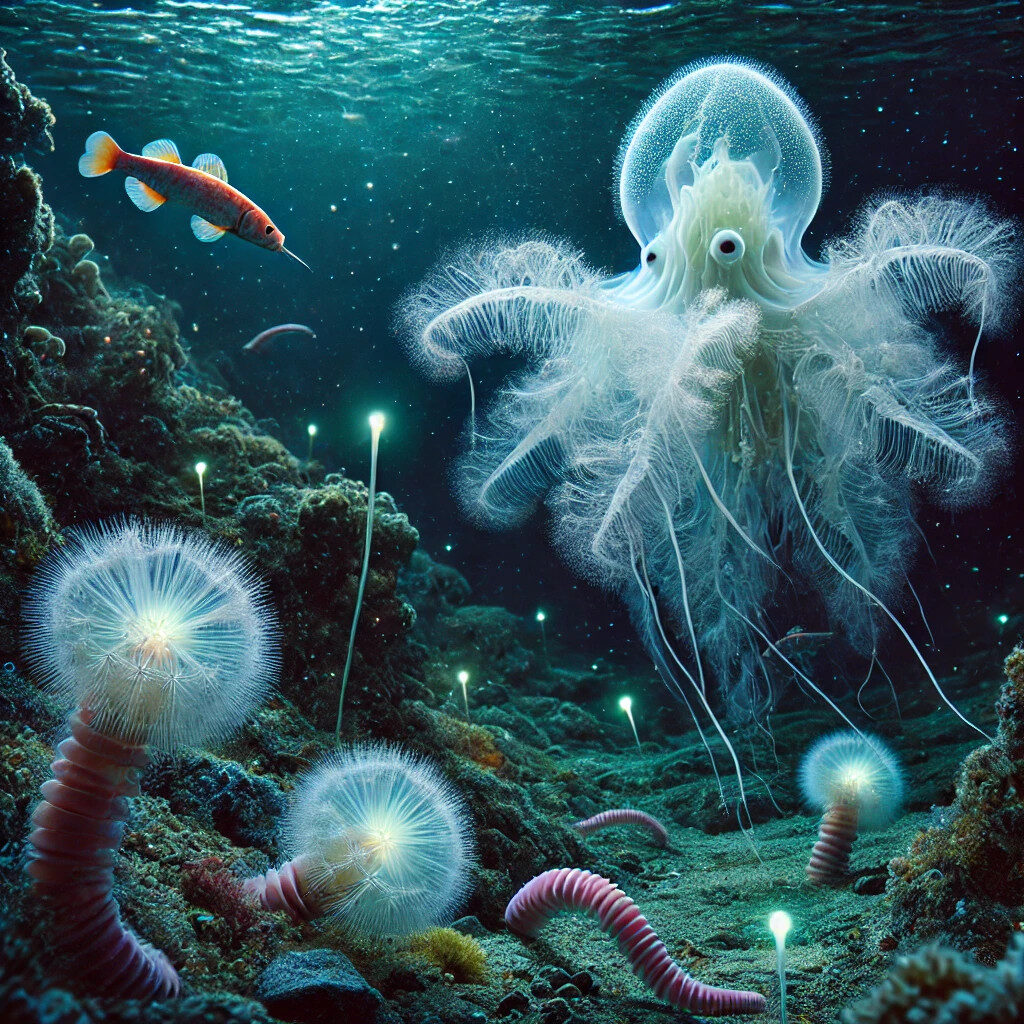
In the past year, marine biologists exploring the depths of the Pacific Ocean have discovered dozens of new species, including ghost-like octopuses, glowing worms, and translucent fish. These strange lifeforms thrive in complete darkness, extreme pressure, and freezing temperatures environments once thought too hostile for life.

One of the most remarkable discoveries was a new type of sea sponge covered in glass-like spikes, found nearly 6,500 meters below the surface. Scientists believe that such creatures have adapted over millions of years, evolving unique survival strategies that remain a mystery to modern science. These deep sea findings not only expand our knowledge of biodiversity but also raise questions about how life might survive on other worlds, such as the oceans beneath Europa, one of Jupiter’s icy moons.
Secrets of the Amazon
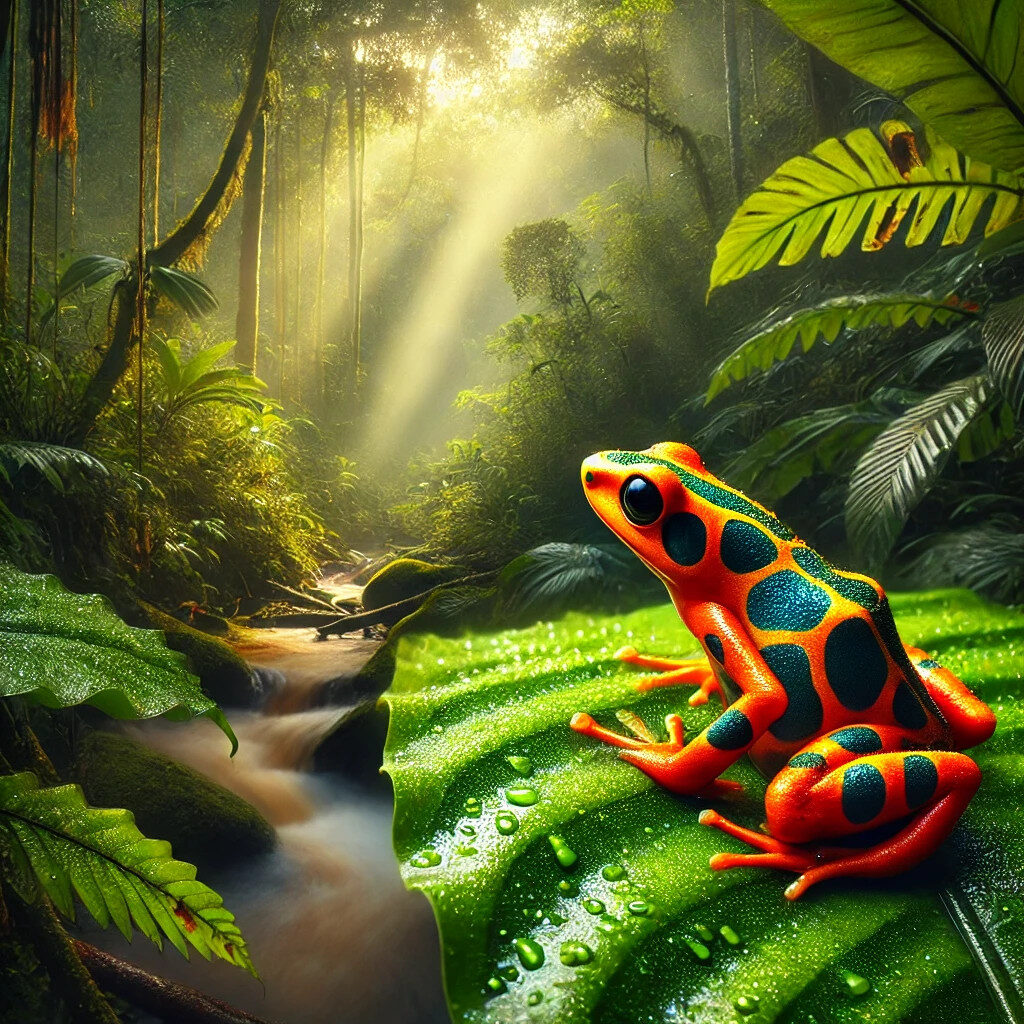
The Amazon rainforest, often called the “lungs of the Earth,” still harbors countless secrets. In recent expeditions, scientists have discovered dozens of new species, including brightly colored frogs, rare orchids, and even tiny mammals that had remained unnoticed for centuries.
One fascinating discovery was a dazzling, neon-blue tarantula species, found lurking in the dense undergrowth. Biologists also identified a plant species capable of “moving” its leaves to trap small insects, a behavior previously unknown among Amazonian flora. Despite ongoing deforestation and habitat loss, these findings remind us that vast parts of the rainforest remain unexplored. Every new species discovered not only adds to our biological catalog but also offers clues about evolution, adaptation, and the interconnectedness of life on our planet.
Life Beneath the Ice
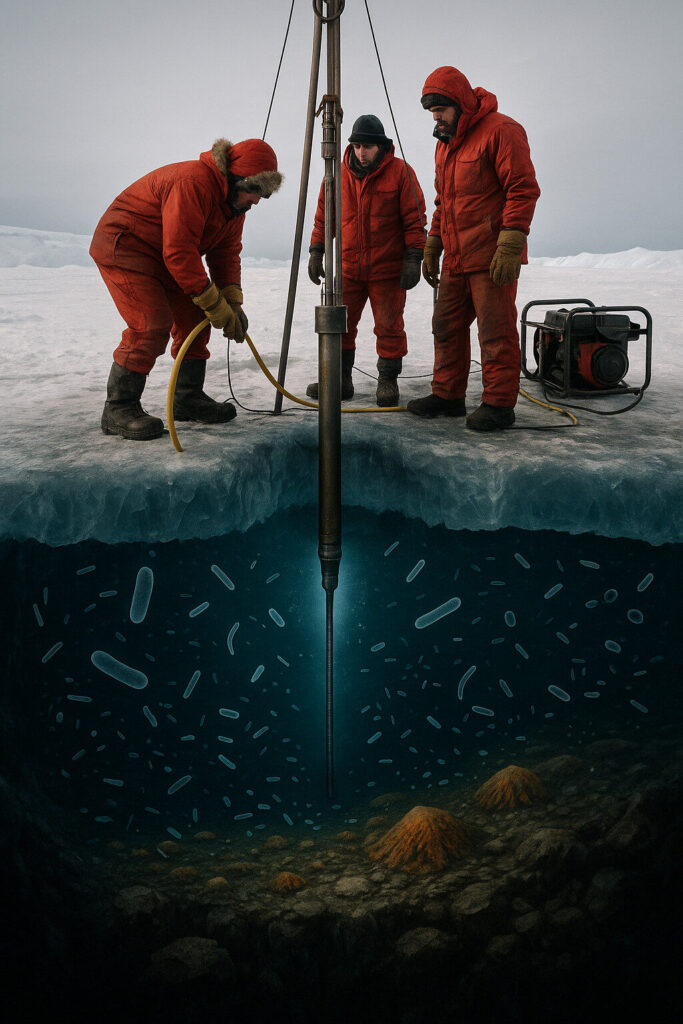
Under kilometers of solid ice, in total darkness and extreme cold, life still finds a way. In recent missions to Antarctica, scientists have drilled through thick ice sheets to explore subglacial lakes and ecosystems that have been sealed off for thousands — even millions — of years.
To their surprise, researchers discovered microbial communities thriving in these isolated environments. Some of these organisms feed on minerals from rocks, while others survive using chemical energy sources, completely independent of sunlight. These findings are transforming our understanding of the limits of life on Earth.
The existence of such lifeforms in harsh, lightless environments also has implications for astrobiology. If life can survive beneath Antarctica’s frozen crust, could similar life exist under the icy surfaces of moons like Europa or Enceladus?
A Planet Still Full of Surprises
From the lightless depths of the oceans to the green chaos of the rainforest and the frozen silence beneath Antarctic ice, recent discoveries show that Earth is still a frontier for exploration. New species, hidden ecosystems, and lifeforms that defy our expectations are being uncovered year after year, often in places we thought we already understood.
These breakthroughs do more than expand our scientific knowledge — they remind us how little we truly know about our own planet. In a time when technology allows us to look deep into space and dream of distant worlds, it’s humbling to realize that many mysteries still lie just beneath our feet.
Perhaps the greatest discovery is this: the more we learn, the more we realize there is still so much to discover — and that the age of exploration is far from over.
References
Li, R., Zhuang, W., Feng, X., Al-Farraj, S. A., Schrecengost, A., Rotterova, J., Beinart, R. A., & Hu, X. (2023). Molecular phylogeny and taxonomy of three anaerobic plagiopyleans (Alveolata: Ciliophora), retrieved from two geographically distant localities in Asia and North America. Zoological Journal of the Linnean Society, 199(2), 493–510. https://doi.org/10.1093/zoolinnean/zlad015
Farminhão, J., Savignac, M., Droissart, V., Lowry, P. P., Rajaonarivelo, N., Ramandimbisoa, B., Verlynde, S., Todivelo, A., & Stévart, T. (2024). A new orchid species expands Darwin’s predicted pollination guild in Madagascar. Current Biology, 34(5), R189–R190. https://doi.org/10.1016/j.cub.2024.01.012
Xia, Z., Heino, J., Liu, F., Yu, F., Xu, C., Hou, M., Zou, X., & Wang, J. (2022). Interspecific variations in fish occupancy and abundance are driven by niche characteristics in a monsoon climate river basin. Journal of Biogeography, 49(12), 2231–2242. https://doi.org/10.1111/jbi.14502
Zou, C., Wang, Q., Si, G., & Chen, C. (2023). A co-anchoring strategy for the synthesis of polar bimodal polyethylene. Nature Communications, 14(1), 1442. https://doi.org/10.1038/s41467-023-37152-1
Gewin, V. (2024). How I’ve helped to discover nearly 40 species in the Amazon. Nature, 630(8017), 786. https://doi.org/10.1038/d41586-024-02030-3
Falcucci, G., Amati, G., Fanelli, P., Krastev, V. K., Polverino, G., Porfiri, M., & Succi, S. (2021). Extreme flow simulations reveal skeletal adaptations of deep-sea sponges. Nature, 595(7868), 537–541. https://doi.org/10.1038/s41586-021-03658-1
Lingam, M., Balbi, A., & Tiwari, M. (2024, August 13). Dwellers in the Deep: Biological Consequences of Dark oxygen. arXiv.org. https://arxiv.org/abs/2408.06841
Zhou, Y., Cui, X., Dai, Z., Zhou, X., Li, L., Jiang, S., & Sun, B. (2024). The Antarctic Subglacial Hydrological Environment and International Drilling Projects: A review. Water, 16(8), 1111. https://doi.org/10.3390/w16081111